

Guardian
Guardian
Couldn't load pickup availability
✓ Instant download after purchase
✓ Single HTML file — no install required
✓ Runs locally in a modern web browser on Windows, macOS, or Linux
✓ One-time purchase — perpetual-use license
✓ U.S. sales only at this time
What is Guardian?
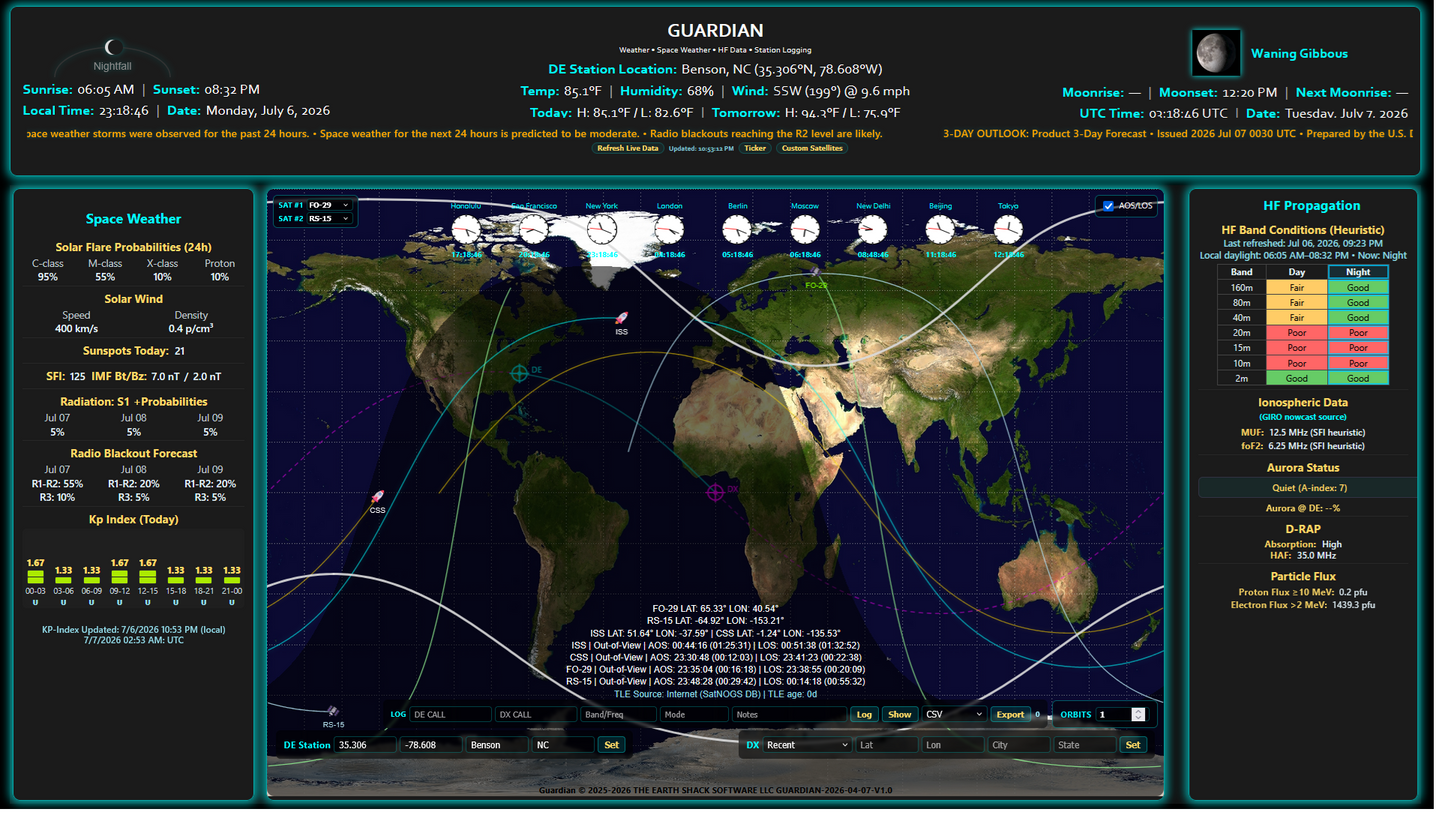
Guardian is a real-time space weather, propagation, and signal-environment situational-awareness display built for operators, communicators, educators, preparedness users, and technical professionals who want current solar, geomagnetic, and signal conditions visible at a glance.
It brings together NOAA/SWPC-powered space-weather data, propagation context, satellite visibility, local reference information, and custom information feeds in a clean, high-contrast interface designed for continuous use on a workstation, second screen, kiosk, or command-wall display.
Guardian is especially useful for radio and satellite operators, but it is not limited to radio use. It is built for anyone who wants to understand conditions that can affect communications, signal behavior, satellite visibility, aurora activity, and the broader near-Earth space environment.
Like all Earth Shack Software tools, Guardian runs as a single HTML file in a modern browser. No server. No account. No installation. Open the file, set your local reference location, and you're operational in under 60 seconds.
Is Guardian right for you?
☀️ Space Weather & Monitoring Users
You track solar activity, geomagnetic storms, aurora conditions, or space-weather impacts. Guardian consolidates key public indicators into one focused situational-awareness display.
🌐 Situational Awareness Users
You want useful environmental and communications context visible without constant interaction. Guardian is designed for full-screen, second-screen, kiosk, and command-wall use where an at-a-glance picture matters.
📡 Communicators & Technical Operators
You monitor signal conditions, propagation windows, satellite visibility, or operating conditions. Guardian helps you see the solar, geomagnetic, and ionospheric context behind changing signal behavior.
🎓 Educators, Demonstrators & Outreach Users
You explain solar activity, aurora, propagation, satellites, or the relationship between space weather and Earth systems. Guardian provides a live visual display that works on any screen and requires no special IT setup.
📻 Radio Hobbyists, HF Operators & DXers
You work HF, VHF, DX, contests, or satellite passes. Guardian gives you current space-weather data, propagation context, aurora status, and satellite timing in a browser-based display that can run beside your station.
Key Capabilities
Space Weather Dashboard
- NOAA/SWPC-powered space-weather display with key solar and geomagnetic indicators
- Kp index, G-scale context, geomagnetic activity, and forecast information
- Solar Flux Index, sunspot count, solar wind speed and density
- IMF Bt/Bz context for monitoring changing geomagnetic conditions
- Aurora status and geomagnetic activity awareness
- D-RAP absorption and radio-blackout context where available
- Particle flux, solar flare probability, and radiation-event awareness
Propagation & Signal Environment
- HF band-condition indicators from 160m through 6m
- Day and night condition columns for quick comparison
- Good/Fair/Poor labels derived from current solar and geomagnetic indicators
- MUF and foF2 heuristic reference values for propagation context
- Signal-environment awareness for operators, communicators, and technical users
- At-a-glance orientation without needing to manage multiple separate web tools
Satellite & Local Reference Context
- ISS and CSS always-on tracking
- SAT 1 and SAT 2 optional overlays with footprint rings and orbit trails
- Saved local reference location for satellite timing and visibility
- Radio users may enter callsign or station context; non-radio users can simply enter the latitude and longitude they want Guardian to use as its local reference point
- AOS/LOS timing for relevant satellite passes
- Custom satellite entry by NORAD catalog ID or pasted TLE
- Useful companion context for satellite-aware operations, monitoring, and demonstrations
Custom Information Feeds
- Custom ticker with up to 5 public RSS/XML feed URLs
- Optional custom text for notes, reminders, or local context
- Useful for monitoring trusted public sources, advisories, bulletins, or operational updates
- Display relevant information alongside space-weather and propagation conditions
- Feeds load best-effort; some sources may be restricted by browser CORS policy or provider settings
Operational Reliability
- Local-first: Guardian runs on your machine. Live feeds refresh when internet is available.
- No account, no server, and no installation required
- Offline-capable core display: last-good space-weather values, clocks, map context, and satellite propagation remain available with reduced capability
- Feed-status indicator showing which sources are fresh, stale, or unavailable
- Persistent settings help preserve your display configuration across sessions
Technical Specs
System Requirements
- Browser: Current versions of Chrome, Edge, Firefox, or Safari. Chromium-based browsers are recommended.
- OS: Windows 10+, macOS 11+, Linux
- Display: 1080p or 4K recommended; other resolutions may work. Optimized for full-screen, second-screen, kiosk, or display-wall use.
- Internet: Optional for core display functions; required for live space-weather feeds, fresh satellite data, weather context, and RSS/XML feed refreshes.
- Install: None. Open the HTML file directly in your browser.
What's Included
- Single self-contained HTML file
- Space-weather and signal-environment dashboard
- HF propagation and band-condition indicators
- Satellite tracking and saved local reference context
- Custom RSS/XML ticker support
- Built-in help documentation
License
- Single-computer, single-user license
- Maintenance updates and improvements may be provided at no additional charge when available. Future major versions, upgrades, or Pro editions may be offered separately.
- U.S. customers only at this time
Works alongside Sentinel
Guardian pairs naturally with Sentinel, our Earth and space situational-awareness display. Guardian focuses on space weather, propagation, solar and geomagnetic activity, satellite visibility, and the signal environment. Sentinel focuses on earthquakes, volcanoes, tectonic context, satellites, grayline, and local weather/alerts. Each product runs independently as its own single-file app, and many users run both side by side.
Frequently Asked Questions
Do I need an internet connection?
No. Guardian runs locally from your machine. When internet is available, it refreshes live feeds such as space-weather data, TLE updates, weather context, and custom ticker feeds. When offline, Guardian continues with reduced capability using last-good values and local computation.
Is Guardian only for ham radio operators?
No. Guardian is useful for ham radio operators, HF/VHF operators, DXers, and satellite users, but it is not limited to that audience. It is designed for anyone who wants space-weather, propagation, solar, geomagnetic, satellite, and signal-environment context in a clean situational-awareness display.
Is Guardian a forecasting tool?
Guardian provides at-a-glance awareness using public data and heuristic indicators. It is not a precision forecasting system and is not designed for safety-critical decision making.
What's the difference between Guardian and Sentinel?
They serve different primary missions. Guardian centers on space weather, propagation conditions, solar and geomagnetic activity, satellite visibility, and the signal environment. Sentinel centers on Earth awareness, geophysical context, satellite visibility, grayline, and local weather/alerts. Both can be useful on their own, and many users run them side by side.
Can I use this on multiple computers?
Your license covers a single computer and single user. If you need additional seats, contact us.
Is there a refund policy?
Yes — see our Refund Policy for details.